

Technical SEO Terms You’ll Hear Us Use
Technical SEO Audit
A technical audit evaluates site health, performance, crawlability, and structural issues that impact rankings.
Core Web Vitals (LCP, INP, CLS)
These metrics measure page speed, interactivity, and visual stability — all critical for user experience and rankings.
Site speed isn’t just about how fast a page loads — it’s about how quickly a user can actually use your website. Google measures this through a set of performance signals called Core Web Vitals, which directly impact both user experience and search visibility.
A slow site creates friction. Visitors abandon pages, conversions drop, and search engines interpret that behavior as a poor experience. A fast site builds trust, keeps users engaged, and supports higher rankings.
Largest Contentful Paint (LCP)
Measures how quickly the main content of a page loads. A slow LCP makes a site feel slow to users and hurts both experience and rankings.
Interaction to Next Paint (INP)
Measures how fast a page responds to user actions like clicks or form submissions. Poor INP means the site feels laggy, even if it loads quickly.
Cumulative Layout Shift (CLS)
Measures how stable a page is while loading. Unexpected layout movement frustrates users, causes misclicks, and signals poor usability to Google.
Indexability and Crawlability
Indexability determines whether pages can appear in search. Crawlability determines whether search engines can access them.
XML Sitemaps and Robots.txt
Sitemaps guide search engines to important pages. Most sites may view their sitemap by going to yourdomain.com/sitemap.xml.
Robots.txt controls which areas of your site can be crawled and can most commonly be found at yourdomain.com/robots.txt.
Canonical Tags
Canonicals tell search engines which version of a page is the primary one to index. This helps to prevent duplicate content, especially in the eCommerce space.
SSL Certificates
SSL encrypts data and signals trust. HTTPS is a baseline SEO requirement. When your site’s domain has http instead of https the search engines are less likely to rank you.
404 Errors, Redirects (301 / 302), and Response Codes
Errors and redirects affect user experience and crawl efficiency. Clean response codes help preserve rankings.
Error Code Breakdown:
200 (OK)
Indicates the page loaded successfully and is accessible to users and search engines. This is the ideal status code for live, indexable pages.
301 (Permanent Redirect)
Signals that a page has permanently moved to a new URL. 301 redirects pass most SEO value to the new page and are used when URLs change, pages are consolidated, or content is relocated.
404 (Not Found)
Means the requested page no longer exists or the URL is incorrect. Too many 404 errors can create a poor user experience and waste crawl budget if not properly managed.
500 (Server Error)
Indicates a server-side issue preventing the page from loading. 500 errors can block search engines from accessing your site and should be fixed quickly to avoid ranking and traffic loss.
Structured Data & Schema Markup
Schema helps search engines understand your content and can enhance visibility with rich results.
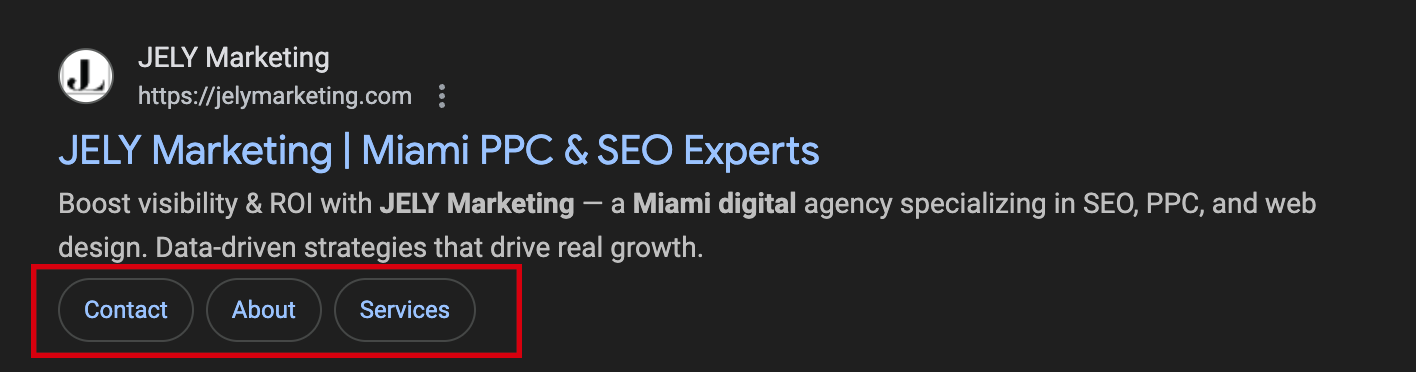
For example, when you add organizational schema, your organic result may see these additional callouts called sitelinks (highlighted in red below). Depending on the schema markup you add, your link could see other expansions such as price point or star-ratings.
LLM.txt and AI Search Optimization
Search is evolving beyond traditional “10 blue links” or “page one ranking.” Large language models (LLMs) now play a growing role in how users discover information through AI-powered search experiences, summaries, and conversational results.
As this shift happens, search engines and AI systems rely more heavily on clear content structure, strong topical signals, and trustworthy sources — not just keywords alone.
That’s where LLM.txt and AI search optimization come into play.
LLM.txt is an emerging, voluntary file concept designed to help AI systems better understand:
- What your site is about
- Which content is authoritative
- How information is structured across your website
Similar to robots.txt or sitemap files, LLM.txt is meant to guide AI models, not control rankings directly. It provides additional context that supports accurate interpretation and citation of your content in AI-generated responses.
Traditional SEO focuses on ranking individual pages for specific queries.
AI-driven search focuses on understanding topics, relationships, and intent across your entire site.
AI systems prioritize:
- Clear explanations over keyword density
- Well-organized content with logical hierarchy
- Authoritative, consistent information across pages
Content that directly answers real user questions
If content is vague, fragmented, or poorly structured, AI systems are less likely to surface it in generated answers.
On-Page SEO Optimization
Metadata (Title Tags & Meta Descriptions)
Title tags and meta descriptions are both forms of metadata, meaning they help search engines and users understand what a page is about before someone clicks. While they appear together in search results, they serve very different purposes.
Title Tags: The Ranking Signal
The title tag is the main clickable headline that appears in search results and in the browser tab. It tells search engines what the page is about and plays a direct role in rankings.
Title tags are one of the strongest on-page SEO signals. They help search engines determine relevance for specific search queries and influence where a page can rank.
What we focus on when optimizing title tags:
- Including the primary keyword naturally
- Keeping titles concise and readable (typically 40–55 characters)
- Front-loading important terms when appropriate
- Making titles clear, accurate, and compelling while not being spammy
A strong title tag balances search intent, keyword relevance, and click appeal.
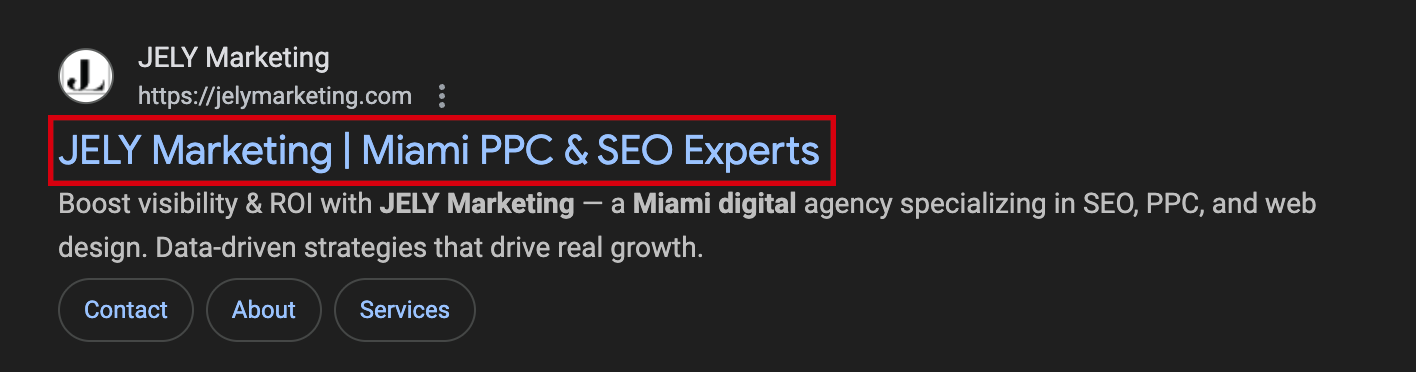
Meta Descriptions: The Click-Through Driver
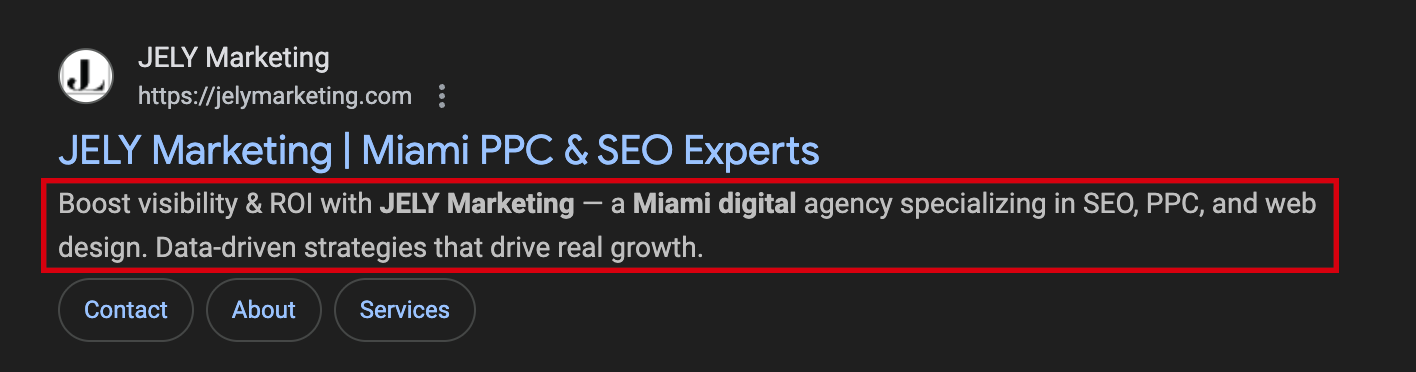
The meta description is the short summary that appears below the title in search results. It does not directly affect rankings, but it strongly influences whether someone clicks.
Meta descriptions act like ad copy for organic search. They set expectations, reinforce relevance, and encourage users to choose your result over competitors.
What we focus on when optimizing meta descriptions:
- Clearly explaining what the page offers
- Matching the user’s search intent
- Including keywords naturally to reinforce relevance
- Using persuasive language without exaggeration
- Staying within optimal length (typically 135–160 characters)
Even though Google may rewrite meta descriptions at times, well-written descriptions increase the likelihood of higher click-through rates.
Think of metadata as a two-part message:
- The title tag tells search engines what the page is about
- The meta description tells users why they should click
When both are aligned, search engines understand the page clearly, and users feel confident selecting it.
Metadata is often one of the highest-impact, lowest-effort SEO optimizations when done correctly.
Header Structure (H1s, H2s, H3s)
Headers create the structural framework of a page. A clear hierarchy helps search engines understand the main topic and supporting subtopics, while also making content easier for users to scan and digest. Proper header structure improves topical relevance, readability, and overall user experience.
Image Optimization and Alt Tags
Image optimization ensures visuals load quickly without sacrificing quality, which improves page speed and performance.
Alt tags provide descriptive text for images, supporting accessibility for screen readers and helping search engines understand image context. Together, they enhance usability, SEO, and visual search visibility.
Content Optimization for Readability and Intent
Optimized content is easy to read, clearly organized, and directly aligned with what the user is searching for. This means concise paragraphs, logical flow, and information that answers the search intent without unnecessary fluff. When content meets intent, engagement and conversions improve.
Featured Snippet Eligibility
Featured snippets highlight content directly at the top of search results. Pages with clear structure, concise answers, and well-formatted sections are more likely to be selected. Earning a featured snippet increases visibility, credibility, and click-through potential.
Content Strategy & Information Architecture
Content Audits
Content audits review existing pages to identify what’s outdated, underperforming, duplicated, or no longer aligned with business goals. This helps determine what should be improved, consolidated, redirected, or removed to strengthen overall site performance.
Content Gap Analysis
Content gap analysis identifies topics and keywords your competitors rank for that your site does not. Filling these gaps helps expand topical authority and capture additional search demand without competing against your own pages.
Information Architecture (IA) Content Matrix
Information architecture defines how pages are organized, connected, and prioritized across your site. Strong IA helps search engines understand page relationships while guiding users logically through content, improving both rankings and usability.
Page-to-Keyword Mapping
Page-to-keyword mapping ensures each important keyword is assigned to a single, clear page. This prevents keyword cannibalization, strengthens relevance signals, and makes SEO efforts more focused and measurable.
Blog Strategy vs Core “Money Pages”
Blogs are designed to educate, attract, and nurture users at earlier stages of the funnel. Core “money pages” target high-intent keywords and are built to convert traffic into leads or customers.
How to Read Your Surfer SEO Content Score
Surfer’s Content Score is a guideline, not a grade. It’s designed to help you understand how well your content aligns with what’s already ranking in Google — not to force your content into a rigid formula.
The Content Score is a value from 0 to 100 that estimates how relevant and competitive your content is compared to top-ranking pages for a specific keyword.
It looks at things like:
- Use of important, contextually relevant terms
- Where those terms appear (headings, paragraphs, metadata)
- Content structure and coverage
- Alignment with search intent
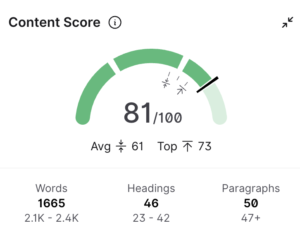
Surfer places less emphasis on word count and keyword repetition and more emphasis on natural language and topical relevance, which better reflects how Google evaluates content today.
Surfer breaks Content Score ranges down like this:
- Below 33 → Content is under-optimized and likely missing important context or depth
- 33–66 → Content is solid and fairly well optimized
- 66+ → Content is competitive and ready to publish
Anything above 66 is considered strong. A score in this range means your content is aligned with what’s already performing well in search results.
Chasing a perfect Content Score can hurt performance. Over-optimizing content to hit every suggested term often reduces clarity and readability. Custom Surfer settings can also limit the maximum possible score, making 100 unrealistic. What matters more is outperforming competitors — a score 10–20 points higher than theirs is usually enough. Ultimately, Google prioritizes search intent, natural language, and helpful answers, not perfect scores.
SEO Timelines & Expectations
The First 30 Days of an SEO Campaign
This phase focuses on audits, research, technical fixes, and strategy alignment — laying the foundation for long-term growth.
The 90-Day SEO Baseline
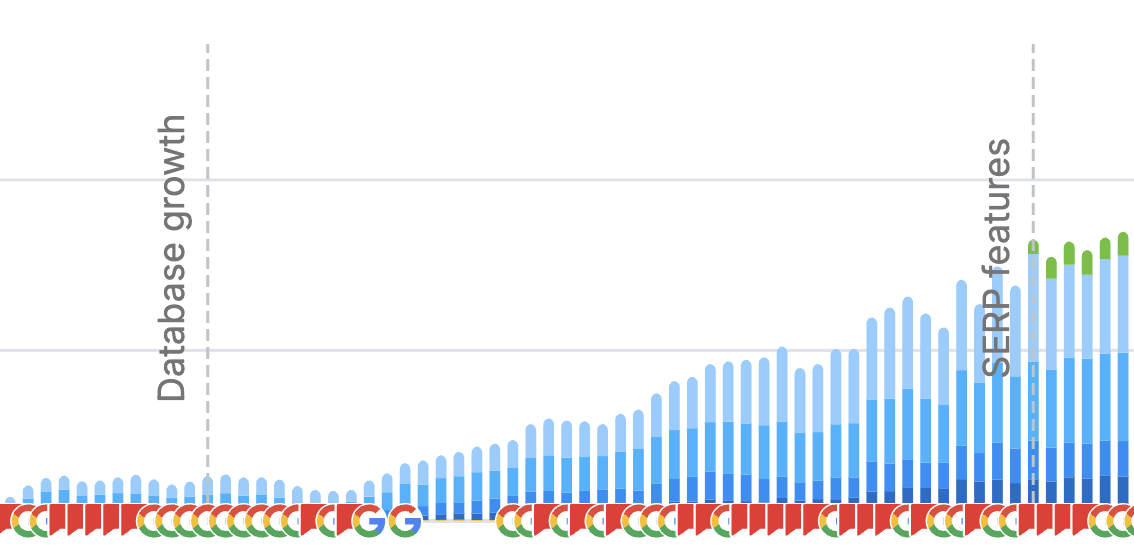
By 90 days, trends in rankings, traffic, and engagement begin to emerge, creating a reliable performance baseline.
Ongoing Monthly SEO Work
SEO is continuous and includes optimization, content development, technical improvements, and authority building.
What SEO “Wins” Look Like Over Time
Real SEO wins are sustainable increases in qualified traffic, leads, and visibility — not short-term spikes.
Common SEO Questions We Get
Why Do Rankings Fluctuate?
Rankings change due to algorithm updates, competition, content changes, and shifts in search behavior.
Why Does SEO Take Time?
SEO requires building trust and authority, which happens gradually through consistent effort and optimization.
How SEO and Conversion Optimization Work Together
Driving traffic is only half the equation — converting that traffic is what turns SEO into revenue.
What Success Actually Looks Like in SEO
Success is measured by consistent growth in relevant traffic, conversions, and business impact — not just keyword positions.