People aren’t just using ChatGPT to get quick answers anymore. They’re researching products, comparing service providers, and working through purchasing decisions.
Naturally, businesses want to know how they can get in front of those potential customers.
With the introduction of ChatGPT Ads in 2026, that’s now possible. Businesses can create paid campaigns that appear inside ChatGPT conversations, giving them another opportunity to reach people while they’re exploring their options.
But before shifting your advertising budget to the latest platform, remember: ChatGPT advertising is still in beta.
It’s a promising opportunity, and there’s value in testing it. However, if your primary goal is generating new leads, we wouldn’t recommend replacing your Google Ads campaigns with ChatGPT advertising.
At JELY Marketing, we see the strongest opportunity in running both platforms together, using Google Ads to reach people actively searching for your services while testing ChatGPT Ads as another way to introduce your business to potential customers.
Here’s how to advertise on ChatGPT, what it costs, and how to decide whether it makes sense for your business.
Can You Advertise on ChatGPT in 2026?
Yes. OpenAI began testing ads in ChatGPT in February 2026 and has since expanded its advertising program.
According to an October 21, 2026 announcement from OpenAI, more than 100,000 advertisers have used ChatGPT Ads, and advertising availability has expanded to 89 countries worldwide.
Businesses in supported markets can create campaigns through OpenAI Ads Manager or approved advertising partners.
Availability depends on the advertiser’s location, account eligibility, and current platform access. Businesses advertising internationally should confirm supported markets through OpenAI’s Ads Manager availability guide.
Where Do ChatGPT Ads Appear?
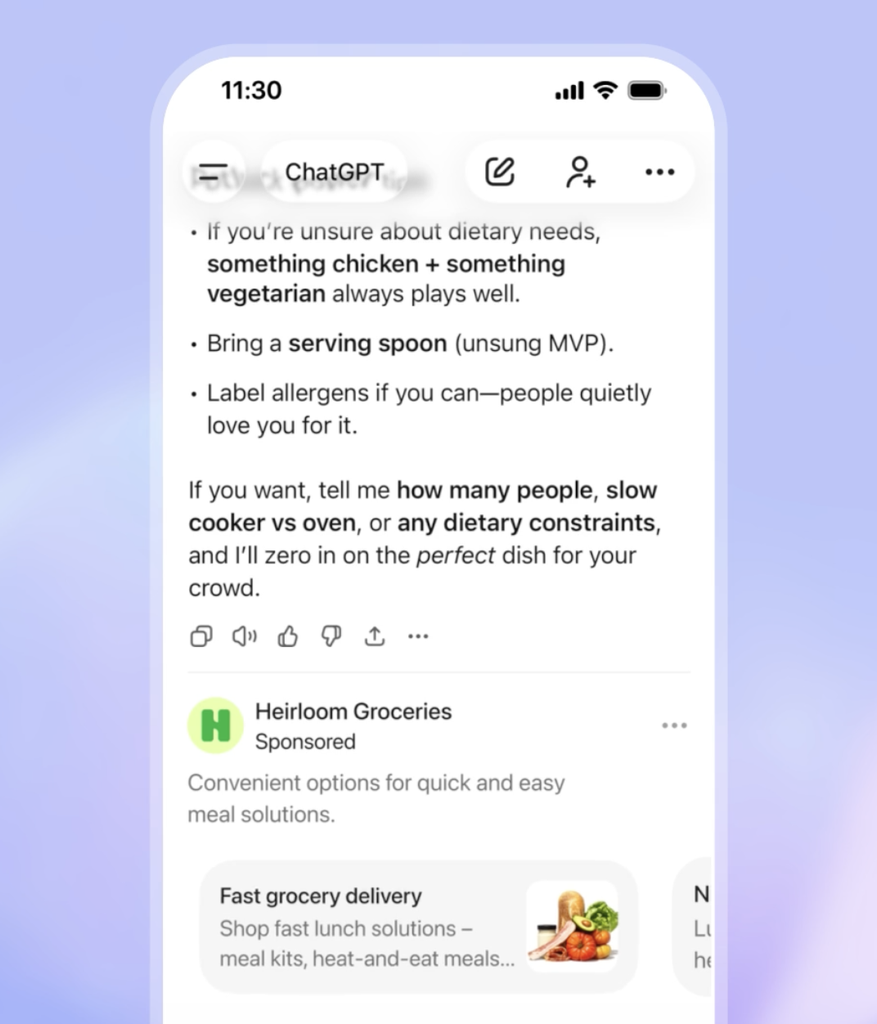
Standard ChatGPT ads appear below the assistant’s response as visually separated, clearly labeled sponsored placements.
These ads can include an advertiser’s name, logo, headline, description, ad image, and a link to the advertiser’s landing page.
The important distinction is that sponsored content does not alter ChatGPT’s answers. Advertisers cannot pay to change what ChatGPT recommends or says within its generated responses.
Not everyone using ChatGPT will see ads, either.
Currently, advertising is shown to eligible users on ChatGPT’s Free and Go plans. Plus, Pro, Business, Enterprise, and Edu plans remain ad-free, and OpenAI does not show ads to accounts identified as belonging to people under 18.
This is also why organic AI visibility and paid ChatGPT advertising are two separate opportunities. Appearing in an AI-generated answer is not the same as purchasing a sponsored placement.
How Does ChatGPT Advertising Work?
ChatGPT advertising works differently from traditional keyword-based search advertising.
With Google Search Ads, businesses can target keywords that potential customers enter into Google. Advertisements may appear on a traditional search results page based on search intent, bids, targeting, and other relevance signals.
ChatGPT Ads, on the other hand, can match ads to the context of an active conversation.
For example, someone might ask ChatGPT whether repairing or replacing a roof makes more financial sense. They may ask follow-up questions about roofing materials, warranties, and the expected installation process.
A roofing company’s advertisement could be relevant while that person is comparing options.
That doesn’t mean the person is ready to request a quote immediately. But it creates an opportunity to introduce a business while someone is considering their next steps.
ChatGPT Ad Targeting Uses Context Hints
Instead of relying exclusively on exact-match keywords, ChatGPT Ads uses several signals to determine relevance.
These include conversational context, the ad’s headline and description, the landing page, advertiser targeting settings, and context hints.
Context hints are simple descriptions advertisers provide at the ad group level to explain when their products or services might be useful.
For example, a residential roofing company could use a context hint such as:
Residential roof replacement services for homeowners comparing repair costs, replacement options, and roofing materials.
That’s more useful than simply entering “roofing company.”
OpenAI’s context hint recommendations encourage advertisers to describe what they offer, who benefits from it, and when the service may be relevant.
However, context hints are not strict targeting rules. They don’t guarantee that an ad will appear during a specific conversation.
ChatGPT advertising also offers supported geographic targeting options and certain audience controls. Custom audiences are available to eligible advertisers, with minimum audience sizes and regional restrictions.
The takeaway is that ChatGPT ad targeting requires businesses to think beyond individual search terms and consider the problems customers are trying to solve.
How to Advertise on ChatGPT Step by Step
If you’re ready to explore AI advertising, the process begins with an advertising account and a strategy for what you want to accomplish.
1. Create Your OpenAI Ads Manager Account
Visit ads.openai.com and begin setting up your business’s advertising account.
During setup, you’ll need to provide advertiser information, configure billing, and complete any required verification.
Before launching your first campaign, confirm that your business category is eligible. OpenAI restricts certain advertising categories, including political ads and other sensitive or regulated content. Some professional services, including eligible legal, financial, and healthcare advertisers, may require additional approval.
You can review the current restrictions in OpenAI’s advertising policies.
2. Select Your Campaign Objectives
During campaign creation, you’ll choose an objective based on what you want the ads to accomplish.
ChatGPT Ads Manager currently offers three primary options:
- Views: Focuses on advertising visibility and uses CPM billing, meaning you pay per thousand impressions.
- Clicks: Focuses on bringing visitors to your website and uses CPC billing, meaning you pay for valid clicks.
- Conversions: Optimizes toward supported conversion events, such as leads or purchases, using eligible click-based or impression-based billing options.
If your business is focused on lead generation, the Clicks or Conversions objectives may be more relevant than simply maximizing impressions.
However, conversion optimization requires appropriate tracking, and selecting that objective doesn’t guarantee new customers.
3. Organize Your Ad Groups and Write Context Hints
Ad groups organize related advertisements around a shared product, service, or customer need. For example, a generator company might create separate ad groups for residential standby generators and commercial backup power systems.
Each would have different customer concerns, ad copy, context hints, and landing pages.
Rather than creating one general campaign that tries to advertise everything, organizing ad groups around specific services helps maintain more relevant messaging.
When you write context hints, use full sentences to describe genuine customer needs. Don’t simply copy a long keyword list into the field.
OpenAI’s ad group guidance recommends creating separate ad groups when different customer situations require different messaging or landing pages.
4. Create Relevant Ad Copy and Images
Your advertisement should be clear about your business offers and why someone might be interested. OpenAI recommends concise headlines and descriptions that communicate practical benefits rather than relying on generic advertising claims.
Imagine a homeowner researching backup power options.
An advertisement that simply says “Best Generator Company” doesn’t provide much useful information.
An advertisement highlighting whole-home generator installation, consultations, and available backup power solutions gives that person a better reason to consider the business.
Your ad image should support that message. A photo of an installed residential standby generator, for example, would be more relevant than a generic stock image of a power outage.
AI tools can help brainstorm headlines and creative variations, but the final advertisement still needs to accurately reflect your services.
5. Make Sure Your Landing Page Continues the Conversation
This is one of the most important parts of ChatGPT advertising. The person clicking your ad has already been researching a particular need. Your landing page should help them continue that process.
If your advertisement promotes whole-home generator installations, the destination page should explain those services, address common concerns, and provide a quick way to request a consultation.
Sending visitors to a generic homepage may force them to search for the same information again.
Effective landing pages should:
- Match the ad’s specific message and service offering.
- Answer relevant questions that someone may have before contacting the company.
- Establish credibility with useful information and appropriate proof.
- Explain what happens next with a clear call to action.
Context hints help the advertising system understand when your ad may be relevant, but they don’t automatically tailor your landing page. That’s something your marketing team needs to plan.
OpenAI’s creative and landing page guidelines specifically recommend using relevant destinations rather than defaulting to generic homepages.
It’s the same principle we follow with Google Ads: relevant messaging and a strong landing page work together to support conversions.
6. Set Up Conversion Tracking Before Launching
Before spending money, you should know what success looks like.
If your objective is generating new leads, you’ll want to measure more than clicks.
ChatGPT Ads provides conversion tracking through the OpenAI Pixel, Conversions API, and supported measurement integrations.
In Ads Manager, advertisers can configure a data source and track supported conversion events, including purchases, lead submissions, and registrations.
The OpenAI Pixel uses website tracking code, while the Conversions API allows eligible events to be sent through a server-side connection.
Your developer or marketing team can configure these tools and test whether events are being recorded correctly.
You should also include UTM parameters in your advertising URLs so traffic from ChatGPT campaigns can be identified in analytics platforms such as Google Analytics 4.
The goal is to understand not just whether someone clicked an advertisement, but whether they completed a meaningful action afterward.
OpenAI provides conversion measurement documentation explaining its supported methods and reporting requirements.
7. Launch Your First Campaign and Monitor Performance
After submitting your ads for review, approved campaigns can begin delivering once the account, billing, and campaign requirements are satisfied.
Your work doesn’t stop there.
ChatGPT Ads Manager provides reporting on impressions, clicks, click-through rate, advertising spend, average CPC, average CPM, and conversions when measurement is configured.
Watch those metrics, but don’t make major decisions based on a small amount of early data.
As with other advertising platforms, you’ll need time to evaluate which messaging generates interest, whether visitors convert, and whether the resulting inquiries are relevant to your business.

How Much Do ChatGPT Ads Cost?
One of the most common questions from businesses interested in the platform is how much ChatGPT advertising costs.
The answer depends on your campaign objective, bidding strategy, competition, and available ad opportunities.
According to OpenAI’s current campaign budget guidance, the minimum daily budget for accounts billed in U.S. dollars is $25 per day. That represents the minimum daily budget setting, not the amount you should necessarily spend to generate meaningful results.
CPC and CPM Campaigns
ChatGPT Ads offers different buying models depending on your campaign objectives.
With CPC campaigns, you pay for valid clicks. OpenAI recommends starting with a maximum CPC bid of approximately $3 to $5. That’s a suggested starting bid, not a guaranteed average CPC or cost per lead.
With CPM campaigns, advertisers set a maximum amount they’re willing to pay per thousand impressions.
ChatGPT Ads uses a relevance-weighted, second-price auction model to select among eligible advertisements.
This means ad selection considers both relevance and bids, rather than automatically awarding the placement to whichever advertiser submits the highest amount.
Actual advertising costs will vary by campaign, industry, competition, and other factors.
What Should You Spend to Test ChatGPT Ads?
For businesses already generating leads through Google Ads, our recommendation would be to allocate a separate test budget rather than significantly reducing spending on a successful campaign.
The appropriate investment depends on your industry, customer value, existing advertising performance, and how much data you need to evaluate the results.
Early advertisers may discover useful opportunities, but there’s no guarantee that ChatGPT Ads will deliver lower acquisition costs simply because the platform is newer.
And while metrics such as click-through rate and cost per click are useful, they’re only part of the picture.
You ultimately want to understand whether your ad spend is helping produce qualified inquiries and paying customers.
Are There Other Types of ChatGPT Ads?
Yes. OpenAI is expanding its advertising platform beyond the initial sponsored placements.
For retail and ecommerce advertisers, product feed campaigns allow businesses to upload structured product catalogs and create ads featuring relevant products, images, prices, and other details.
OpenAI also announced Sponsored Agents, an experimental format that allows users to initiate a conversation with an AI representative of an advertiser. Sponsored Agents are currently limited to selected advertisers in an alpha test and are not generally available through standard account signup.
These developments demonstrate how AI advertising may continue to evolve. However, businesses should plan around the capabilities available to their own accounts today rather than assuming every experimental format is accessible.
ChatGPT Ads vs. Google Ads for Lead Generation
One of the biggest questions businesses have is whether ChatGPT advertising will replace Google Ads.
Our answer, at least for now, is no. Both platforms can serve a purpose, but they approach customer intent differently.
| Google Search Ads | ChatGPT Ads | |
|---|---|---|
| Primary opportunity | Reach people searching for relevant products or services | Reach people researching needs, options, and purchasing decisions |
| Ad targeting | Keywords, location, audiences, and other signals | Conversational context, context hints, location, and supported audience controls |
| Where ads appear | Google search results | Sponsored placements within ChatGPT |
| Platform maturity | Established advertising platform | Still in beta |
| Lead generation role | Core channel for capturing active search demand | Additional channel worth testing |
| Measurement | Established conversion tracking and optimization capabilities | Conversion tracking and reporting tools that continue to evolve |
Google Ads gives businesses the ability to target people actively searching for their offerings.
Someone searching for “commercial roofing contractor” or “criminal defense attorney in Chicago” may already be looking for someone to hire.
ChatGPT advertising might reach that same person earlier, while they’re researching their situation and comparing options.
That creates another opportunity, but it doesn’t necessarily mean they’re ready to contact a company immediately.
For businesses that depend on a consistent flow of new inquiries, that difference matters.
Why We Recommend Running ChatGPT Ads and Google Ads Together
At JELY Marketing, we’re interested in testing new platforms when they create legitimate opportunities for our clients. We also believe there should be a strategy behind where your marketing dollars go.
If your goal is generating new leads, our approach to ChatGPT advertising is to run it alongside Google Ads, not as a replacement.
For businesses working with JELY on ChatGPT Ads, Google Ads will also be part of the paid advertising strategy.
Google Ads Helps Capture Existing Demand
Google Search campaigns can reach potential customers who are actively looking for a particular service. For many service businesses, those searches represent opportunities to connect with people already considering a purchase, appointment, or quote.
Our Google Ads management services focus on identifying relevant search demand, developing campaigns around business goals, and continuously improving performance.
ChatGPT Ads Creates Another Opportunity to Reach Potential Customers
ChatGPT advertising gives businesses a way to appear while people are exploring a problem or comparing possible solutions. That can be valuable when a product or service requires research before someone is ready to make a purchasing decision.
Advertising on both platforms creates opportunities to reach potential customers at different stages of the process.
It doesn’t mean the two platforms will always reach the same people or that an impression on ChatGPT automatically creates a future Google search.
But it does give businesses another way to introduce their services.
Testing Shouldn’t Come at the Expense of Proven Results
There’s understandable excitement around new advertising opportunities, especially when a platform is growing quickly.
But early adoption doesn’t guarantee better performance.
We’d rather help a business maintain its existing lead-generation efforts while testing whether ChatGPT advertising can provide additional value.
If the results are promising, we can evaluate expanding the campaigns.
If they’re not, the business still has its established advertising strategy in place.
How Do You Know if ChatGPT Ads Are Actually Working?
Clicks and impressions tell you whether people are seeing and interacting with your advertising.
But for a lead-generation business, the most important questions come afterward.
Did someone submit a contact form? Was the inquiry qualified? Did your team follow up? Did that prospect eventually become a paying customer?
With properly configured conversion tracking, analytics, and CRM integrations, businesses can begin connecting ad interactions to those outcomes.
This makes it possible to evaluate more meaningful performance metrics, including cost per lead, conversion rate, and cost per acquired customer.
It’s also important to recognize that different advertising and analytics platforms may attribute conversions differently. A lead might interact with several marketing channels before taking action, so reports should be reviewed with those differences in mind.
For JELY, this is another reason to look beyond the initial conversion. We’ve discussed the importance of speed to lead and how quickly responding to inquiries can affect opportunities to convert them. Generating a qualified lead won’t accomplish much if no one follows up.
As businesses test additional advertising platforms, understanding what happens after the click becomes even more important.
Is ChatGPT Advertising Worth Testing for Your Business?
Potentially, yes.
ChatGPT Ads offers businesses an opportunity to reach people while they’re researching needs, comparing solutions, and deciding what to do next.
But whether it’s worth testing depends on your business goals and existing marketing strategy.
If you’re already generating consistent leads through Google Ads, have a well-functioning website, and can allocate additional advertising spend to experimentation, ChatGPT may be a worthwhile next channel to explore.
If your business needs new leads immediately and doesn’t have an established paid search strategy, we’d generally recommend starting with Google Ads.
The same applies if your website isn’t converting visitors, your follow-up process is inconsistent, or you have limited insight into which campaigns are generating actual customers. Adding another advertising platform won’t automatically solve those problems.
ChatGPT Ads is still developing, and its targeting, measurement, and creative capabilities will continue changing.
The businesses that benefit most will be those that approach it with clear objectives, reliable tracking, and realistic expectations.
Build a Paid Advertising Strategy That Makes Sense for Your Business
ChatGPT advertising is an exciting development in digital marketing, and we’re looking forward to seeing how it continues to evolve.
As more people use AI tools to research products, compare providers, and work through purchasing decisions, businesses have new opportunities to reach potential customers.
But new advertising opportunities shouldn’t replace a strategy that’s already producing results.
At JELY Marketing, our approach is to combine established lead-generation channels with thoughtful testing of emerging platforms.
For businesses interested in ChatGPT Ads, that means developing a strategy that includes Google Ads, determining where ChatGPT advertising may fit, and measuring performance across both channels.
The objective isn’t simply to advertise on the newest platform. It’s to put your marketing budget to work in places that make sense for your business.
Interested in exploring ChatGPT Ads alongside Google Ads? Request a Quote to discuss your goals and determine whether a combined advertising strategy is the right fit.