
Google AI Mode isn’t killing SEO. It’s changing how search works by giving direct, conversational answers. This shift exposes weak SEO more than it harms strong SEO. If you run a business, manage marketing, or oversee a website and wonder what this means for your rankings, traffic, and visibility, the businesses feeling the biggest impact are usually those that were already cutting corners.
If your SEO is built on organic value, clear answers, and credible information, this AI-driven search experience isn’t the end of the road. It raises the bar. Below, we break down:
- How Google AI Mode is changing search results
- Why weak SEO loses ground while strong SEO holds up
- How E-E-A-T and helpful content matter more than ever
- What happens to traffic quality as clicks become more selective
- How to build a sustainable SEO strategy that stays relevant as AI search evolves.
What Google AI Mode Changed About Searching
Google AI Mode is changing how people get answers on Google. Instead of showing a list of blue links, it introduces an AI-powered change in Google search and a major shift in how the search engine delivers answers through new search functions. Users often get what they need without clicking through to websites. This is a big shift from traditional SEO and search engine optimization, not just a departure from classic search or the earlier search generative experience. Google AI search mode is now rolling out AI results as a default experience for millions of users, marking one of the biggest changes in search behavior and architecture in 25 years.
How AI Mode Works Inside Chrome
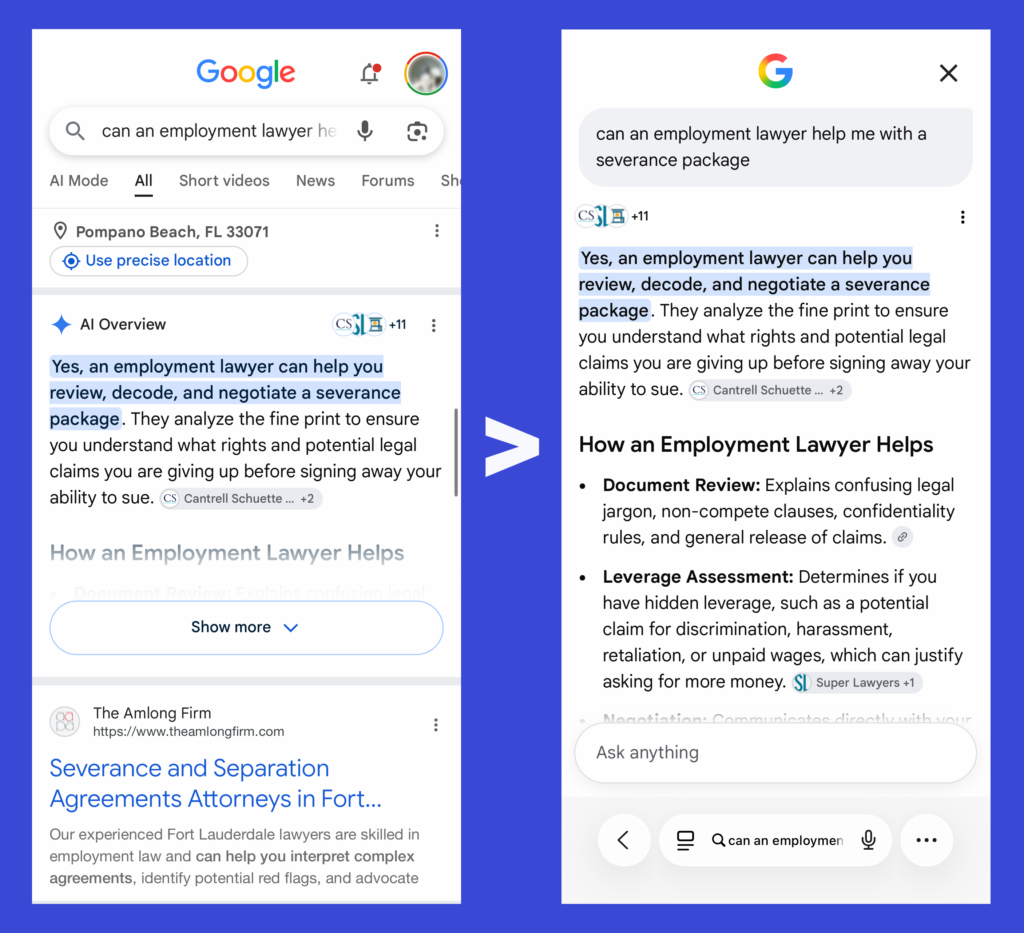
AI Mode integrates closely with Chrome, letting users ask longer, natural-language questions and follow-up questions without leaving the AI interface. This matters because answer engines work differently on complex queries through a custom version of the company’s Gemini model. It pulls information from multiple sources on the open web, synthesizing answers in one place.
SEO strategy now has to anticipate follow-up questions instead of relying solely on a single user’s query. This layered experience encourages exploration but keeps people within Google’s AI environment, with AI Mode responses shaped by a fan-out technique that expands beyond the user’s query.
Why Business Owners are Suddenly Asking if SEO Still Matters
Fewer clicks are happening on simple informational searches. AI Overviews have lowered click-through rates by 58%, and zero-click searches now account for 36% of searches in the US. Some sites may see website or organic traffic fall by 20 to 60% as AI answers absorb more informational visits. This has business owners wondering if investing in SEO is still worthwhile when the real question is how to measure lost clicks against business outcomes.
Why AI Mode Rewards Strong SEO and Punishes Weak SEO
AI Mode doesn’t just pick any content to answer questions. Visibility often depends on earning a citation inside an AI-generated response, not just ranking in traditional search. AEO is about improving your chances of being cited in AI summaries and other AI results. Weak SEO, the kind built on shortcuts, gets left behind. Content with strong E-E-A-T signals and helpful content has more potential to support brand visibility through citations in AI Mode.
What Weak SEO Looks Like
Thin content that adds little value, keyword stuffing, and pages designed only to game algorithms instead of serving real people, including low-quality AI-generated articles published at scale. This kind of SEO never worked well, and AI just makes it more obvious. Weak AI SEO often comes from leaning on AI tools to create content that is just keywords deep instead of using AI to strengthen existing pages with real substance.
What Strong SEO Looks Like
Content based on firsthand experience, original data, and a clear point of view better matches user intent and supports visibility in AI-generated answers. It uses structured formatting to organize content clearly, with strong content structure and long-form depth that improve the odds of being cited by AI systems. E-E-A-T is crucial for AI-generated content visibility. These are qualities AI can’t reduce to a simple summary. Strong pages come from optimizing content around real questions, not only surface summaries.
Where E-E-A-T fits in
Experience, Expertise, Authority, and Trustworthiness form not just a quality standard but part of the trust hierarchy AI uses when deciding what to cite in AI Mode. Google’s ranking systems also use those authority and trust signals in how AI understands your content. Showing you know your stuff and can be trusted is more important than ever.
What This Means for Your Business
You are Not Losing All Your Traffic, but the Visitors you Keep are More Qualified
While overall visits might drop, the clicks you do earn often bring more qualified traffic, with visitors better aligned with your conversion goals and more likely to be interested and engaged. That means better leads, more meaningful connections, and for local businesses, more in-store visits.
The Real Thing Dying is the Rank-and-Hope Approach
The old way of hoping to rank by stuffing keywords or spinning content isn’t going to cut it. What still matters is solid SEO fundamentals and technical SEO that support real value and clear answers. There are no separate AI hacks here, just stronger SEO tactics built on the same base to stay ahead. Traditional SEO still matters when paired with an up-to-date content strategy.
Why This is Not a Panic Moment
AI Mode is still growing and represents a small share of searches today. Businesses should prepare now because AI-powered search is changing how people discover information across Google. The smart move is not to chase every new trend around AI models or AI agents but to steadily build durable content practices that hold up as AI search evolves.
How to Build SEO That Holds Up in AI Search
Lead with Expertise and a Human Point of View, Not Just Data
Your content should reflect real knowledge and experience. Speak directly to your audience’s concerns with honesty and clarity, showing you understand user intent and can answer complex questions clearly. Create helpful content for people first, not for AI summaries alone.
Structure Your Content so Both People and AI Can Trust it
Use clear headings, bullet points, and straightforward language. Make it easy for AI to parse your content with logical sections and formatting that supports AI-powered answers, and for visitors to find what they need quickly. Adding structured data and schema markup helps Google interpret the page. Using semantic markup such as article schema can improve the chances of being cited. This can also strengthen visibility in featured snippets, the knowledge graph, and visual search.
Play the Long Game Because Consistency Beats Shortcuts Every Time
SEO isn’t a quick fix. Consistently publishing well-crafted content and maintaining your site’s health through optimized websites and technical SEO fundamentals helps ensure seamless crawling and indexing. This pays off far more than chasing hacks. That also means monitoring core web vitals to keep pages fast and reliable over time.
How JELY Thinks About SEO in the AI Era
We have always built SEO with the real person on the other side of the screen in mind. In the AI era, that means measuring visibility across both classic Search and AI surfaces with a publishing approach built for multiple formats. AI only makes that focus non-negotiable. We won’t promise overnight miracles or guaranteed rankings because no one can. But we will promise steady work aimed at helping your business grow sustainably in this changing landscape.
Before you make big changes, monitor search console data in Google Search Console, including the Generative AI Performance Report, and compare it with Google Analytics to understand shifts in traffic and citations. If you want to talk about how to prepare your SEO for the future, Contact Us. We’re here to help you build something that lasts.